




Introduction: The Evolution of Natural Feed Additives in Modern Poultry Nutrition
The global poultry industry has undergone a profound transformation in recent decades, driven by regulatory changes, shifting consumer preferences, and scientific advancements. The ban on antibiotic growth promoters (AGPs) in many regions forced nutritionists to seek alternative solutions to maintain animal performance, health, and profitability. This shift accelerated the development and adoption of phytogenic feed additives—natural, plant-derived compounds known for their antimicrobial, digestive, and immune-modulating properties.
Initially, phytogenics were valued primarily for their ability to replace AGPs by suppressing harmful bacteria in the gut. However, as research deepened, their broader benefits became evident: they modulate gut microbiota, enhance nutrient absorption, strengthen gut integrity, and support immune function. Despite these advantages, early phytogenic products faced challenges, including inconsistent efficacy, poor stability during feed processing, and variable palatability. Many first-generation additives were volatile, dusty, or irritating, limiting their practical application in commercial farming.
Today, the industry stands at the threshold of a new era. Advanced technologies, such as micro-encapsulation, have addressed these limitations, enabling the development of highly concentrated, stable, and targeted-release feed additives. These innovations not only improve animal performance but also align with the growing demand for sustainable, natural, and economically viable solutions in poultry production.
While phytogenics have dominated the market for decades now, a new frontier is emerging: phycogenics, or algae-derived feed additives. Unlike traditional plant-based solutions, phycogenics leverage the unique bioactive compounds found in marine algae, such as seaweeds. These compounds offer distinct advantages, including novel antimicrobial properties, enhanced gut health modulation, and improved nutrient utilization.
Research into phycogenics is still in its early stages, but preliminary findings are promising. Rather than treating algae as a simple nutrient source, scientists are now focusing on identifying and isolating specific metabolites that can optimize animal physiology. For example, certain seaweed extracts have been shown to:
- Stimulate beneficial gut bacteria while inhibiting pathogens.
- Enhance mucus production and epithelial cell growth, strengthening gut integrity.
- Modulate immune responses, reducing inflammation and improving disease resistance.
The potential of phycogenics is further amplified when combined with advanced processing techniques, such as micro-encapsulation. This synergy allows for the creation of highly stable, low-dose additives that deliver consistent results even in complex diets containing enzymes, emulsifiers, and probiotics.
Setting a New Standard: Phytogenics, phycogenics, and Micro-Encapsulation

The evolution of phytogenic and phycogenic feed additives highlights the importance of manufacturing expertise. Early products, while innovative, often struggled with stability issues, poor handling characteristics, and inconsistent efficacy. For instance, volatile essential oils could degrade during feed processing, while dusty or irritating formulations posed risks to both animals and workers. Modern advancements have overcome these challenges through precision encapsulation technologies (cf XPR©). Today’s leading feed additives are:
- Highly concentrated, allowing for lower inclusion rates without sacrificing efficacy.
- Stable under harsh processing conditions, such as extrusion and pelletization.
- Dust-free and non-irritating, ensuring safety and ease of handling.
- Designed for targeted release, delivering active compounds precisely where they are needed in the digestive tract.
However, the term “encapsulated” has become widely used—and sometimes overused—in marketing. It is essential for producers to verify suppliers’ claims and ensure that products are backed by rigorous scientific validation rather than mere promotional language. True innovation lies in additives that combine proven stability, transparent formulations, and demonstrated efficacy in real-world farming conditions.
The future of feed additives lies in the integration of phytogenic and phycogenic compounds with advanced delivery systems. Recent breakthroughs have led to the development of next-generation products that outperform traditional solutions in several key areas:
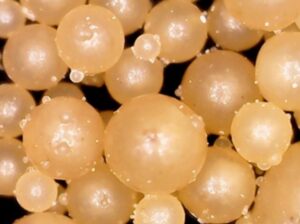
- Precision Release: Micro-encapsulation ensures that active ingredients are released at the optimal site in the gut, maximizing their impact on digestion, nutrient absorption, and immune function.
- Enhanced Stability: These additives remain effective throughout feed processing and storage, even under challenging conditions.
- Low-Dose Efficacy: High concentrations of active compounds allow for lower inclusion rates, reducing costs while maintaining performance benefits.
- Sustainability: By improving feed efficiency and reducing the need for synthetic additives, these technologies support environmentally responsible farming practices.
Extensive research has demonstrated that these advanced feed additives optimize animal performance by:
- Stimulating digestive enzymes, enhancing nutrient utilization.
- Strengthening gut barrier function, reducing the risk of infections and inflammation.
- Modulating immune responses, improving overall health and resilience.
- Delivering a strong return on investment (ROI), even at minimal dosages.
Case Study: Validating Efficacy in Complex Diets
A recent trial conducted at Sri Ramadhootha Poultry Research in Hyderabad, India, provides a real-world example of how low-dose feed technologies can enhance performance in complex diets. The study evaluated the effects of a phytogenic-phycogenic encapsulation (NUQO©) in broiler diets already supplemented with emulsifiers and probiotics.Trial Design:
- 870 day-old Cobb 430 Y chicks were divided into two groups:
- Control Group: Standard diet with emulsifiers (500g/ton) and probiotics (50g/ton).
- Test Group: Same diet plus 75g/ton of the advanced additive.
- Both groups received a corn- and soybean-based diet enriched with phytase, NSP enzymes, toxin binders, and a coccidiostat.
- Performance metrics, including body weight, feed intake, feed efficiency, and slaughter traits, were recorded at 21 days and slaughter.
Key Results:
- Superior feed efficiency (P < 0.05) in the test group at both 21 days and slaughter, indicating better nutrient utilization.
- 2% higher body weight at slaughter, demonstrating enhanced growth performance.
- Remarkable ROI of 7:1, based on current feed prices in India.
- Lower liver weight in the test group, suggesting improved liver metabolism and reduced fat accumulation, while remaining within healthy ranges.
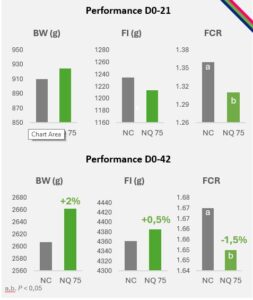
This trial underscores the added value of low-dose feed technologies in complex diets. By integrating seamlessly with existing additives—such as enzymes, emulsifiers, and probiotics—these innovations enhance overall performance without disrupting dietary balance. The result is a win-win for producers: improved animal health, higher efficiency, and greater profitability.
Conclusion: The Future of Feed Additives in Poultry Nutrition
The transition from first-generation phytogenics to advanced phytogenic-phycogenic encapsulated technologies represents a paradigm shift in animal nutrition. By combining plant and algae-derived metabolites with cutting-edge encapsulation, these innovations address the limitations of earlier products while delivering unmatched efficacy, stability, and economic value.
As the poultry industry continues to evolve, the demand for natural, sustainable, and high-performance feed solutions will only grow. Low-dose feed technologies are poised to play a central role in meeting these demands, offering producers a way to:
- Enhance animal performance through improved digestion, gut health, and immune function.
- Reduce costs by maximizing feed efficiency and minimizing waste.
- Support sustainability by decreasing reliance on synthetic additives and promoting responsible farming practices.
Ultimately, the integration of phytogenics, phycogenics, and advanced delivery systems sets a new standard for feed additives – one that prioritizes science, transparency, and real-world results. For producers seeking to optimize their operations, these technologies represent not just an alternative to traditional solutions, but a pathway to the future of poultry nutrition.
For more information, please visit: https://www.nuqo.eu/